Does font subsetting improve LCP (or only file size)?
Smaller WOFF2 files always help bandwidth. Largest Contentful Paint only moves when the LCP element is text (or font work was blocking the real candidate). Use this cheat-sheet before the subsetting ticket.
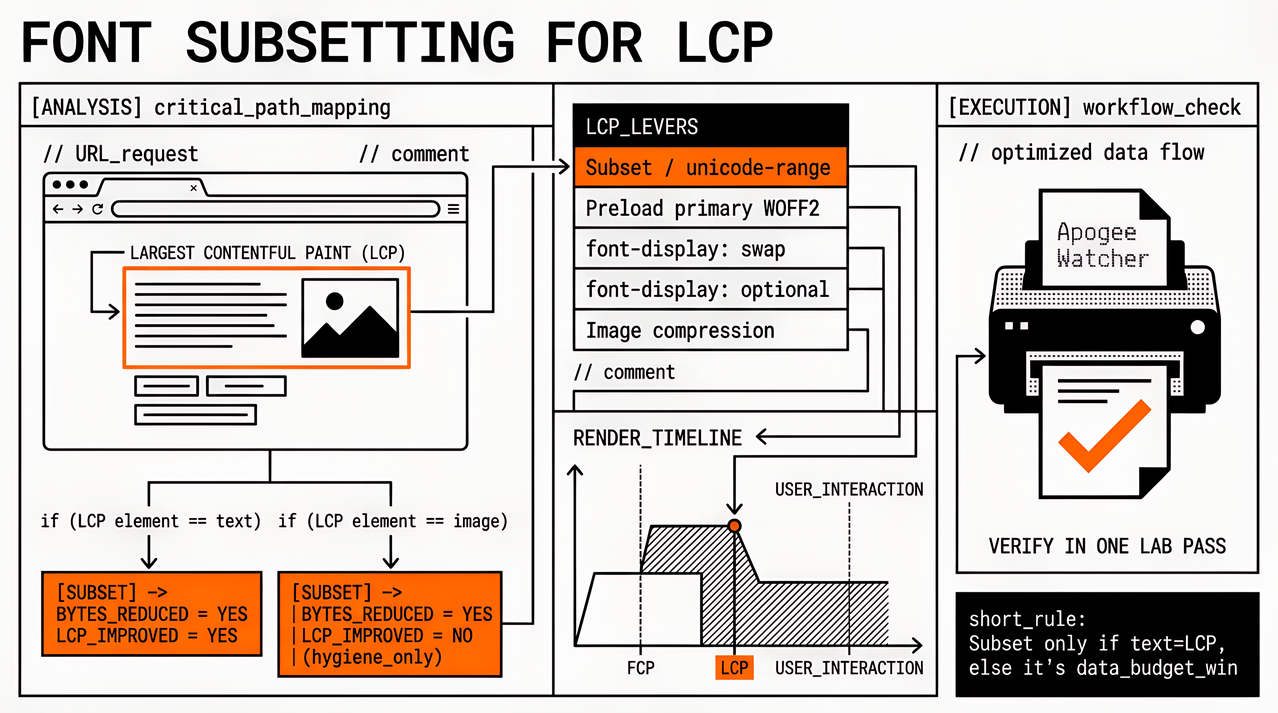
Font subsetting almost always reduces transferred bytes. That is not the same claim as “Largest Contentful Paint will improve.” Teams burn a sprint trimming glyphs while the LCP element is still a product image, a hero poster, or a background video frame: the file gets leaner, but the Core Web Vitals story does not move. The useful question is conditional. Does subsetting sit on the critical path to the actual LCP candidate on this URL?
Watcher’s Font Subsetting for Web Performance post covers tools and workflow (Apogee Watcher). When the LCP element is imagery, pair that with Image optimisation strategies for better LCP scores. What follows is the decision cheat-sheet: when subsetting is an LCP lever, when it is only a file-size win, and how to verify in one lab pass.
Font subsetting versus file size versus LCP paint timing
Subsetting builds a font resource that contains fewer glyphs (and often fewer OpenType features) than the full family file. With unicode-range and WOFF2, the browser can download only the script block the page needs. web.dev’s guidance on reducing webfont size and font best practices is clear that smaller font files help text render sooner when text depends on that face.
Largest Contentful Paint measures when the largest content element in the viewport finishes rendering. If that element is a text node that uses the web font, shaving font download and parse time can move LCP. If that element is an image, font bytes still compete for bandwidth and main-thread time, but they are not the LCP resource. You may still want subsetting for First Contentful Paint, brand consistency, and mobile data budgets; just do not write the ticket as “fix LCP via subsetting” until you have named the LCP element.
When font subsetting improves LCP
| Situation | Likely LCP effect of subsetting | Notes |
|---|---|---|
| LCP element is a headline or body block in a custom face | Often yes | Smaller face + sensible font-display / preload of that one file |
| LCP element is an image or video poster | Mostly file size / FCP only | Subset anyway for hygiene; fix images first for LCP |
| Full CJK or mega family on a Latin-only page | Yes for text LCP; large byte win either way | unicode-range splits stop unused scripts |
| Many weights/italics unused | Indirect | Dropping unused faces helps more than micro-glyph trims |
| Font was render-blocking a long chain before the image LCP | Sometimes yes | Subsetting helps; also check preload priority and CSS order |
The short rule: subsetting improves LCP when text is the LCP element, or when font work was clearly delaying discovery of the real candidate. Otherwise you are buying bytes and polish, which is still valuable, just under a different KPI.
Font subsetting vs preload vs font-display for LCP
These levers compose. They are not substitutes.
| Lever | Primary job | LCP caveat |
|---|---|---|
Subsetting / unicode-range |
Fewer bytes per face | Helps text LCP; limited if LCP is media |
| Preload one primary WOFF2 | Earlier fetch of the face that paints the hero text | Wrong preload competes with the image LCP |
font-display: swap |
Show fallback text sooner | Can improve perceived text; may raise CLS if metrics differ |
font-display: optional / similar |
Avoid late swaps | May skip the web font on slow links; LCP text might stay on fallback |
| Image compression / priority | Media LCP | Often the real LCP ticket on marketing and ecommerce pages |
web.dev’s optimize LCP and CSS Web Vitals notes treat fonts as one delay class among several. Start from the element on the page you are fixing, not from whichever font tip is circulating that week.
How to verify whether font subsetting moved LCP
What usually works:
- Open Chrome Performance or Lighthouse on the URL and name the LCP element (text node versus image).
- If it is text, record the font URL’s transferred size and whether it is render-critical.
- Subset or split with
unicode-range, keep one preload for the primary Latin face only, and re-run the same lab recipe. - If it is an image, park the subsetting ticket under “font budget” and open the image LCP checklist instead.
- Watch CLS if you change
font-display; a faster text paint that shifts layout is a different regression.
Pin Lighthouse version and throttling when you compare before/after. One noisy UI paste is not a subsetting study, so keep the same recipe and the same URL, then argue about glyphs.
FAQ
Is a smaller font file always worth it?
Usually yes for bandwidth and parse cost, especially on mobile. Sell it as a font budget win when LCP is media-led.
Does subsetting fix CLS?
No. CLS from fonts comes from fallback versus web-font metric differences and swap behaviour, not from glyph count alone.
Do we need custom tooling?
Not always. Google Fonts and many foundries already subset; self-hosted pipelines use pyftsubset and friends. Watcher’s tools post lists practical options.
Name the LCP element before you subset fonts
Performance engineers: before the next “subset for LCP” ticket, screenshot the LCP element and label it text or image. That is the conditional question from the opening, answered with an artefact instead of a hope. If it is text, follow Font subsetting for web performance for the build steps. If it is an image, switch to Image optimisation strategies for better LCP scores and keep subsetting as a parallel hygiene task. Shipping glyph trims against a hero JPEG is how sprints look busy while LCP stands still. For scheduled lab checks on the URLs that matter, start a Watcher trial.
References
- Reduce webfont size (web.dev)
- Best practices for fonts (web.dev)
- Optimize Largest Contentful Paint (web.dev)
- CSS for Web Vitals (web.dev)
- Font Subsetting for Web Performance: 4 Tools… (Apogee Watcher)
- Image optimisation strategies for better LCP scores (Apogee Watcher)
About the author
- Apogee Information Systems operates at the intersection of digital transformation for international organisations, innovative e-learning, public service automation, and specialised commercial solutions. Currently building Apogee Watcher, a web performance tool for agencies and solopreneurs.
Comments
Join the discussionNaming the actual LCP element before cutting a font subsetting ticket saves so much wasted sprint work—if the hero image or poster frame is already the LCP candidate, shrinking WOFF2 bytes barely touches Core Web Vitals.