We Sold PageSpeed Retainers for Years. Here Is Why We Productised Monitoring Instead of Another Audit PDF
Productise the calendar, not the PDF: how we turned a PageSpeed retainer continuity problem into multi-tenant monitoring.
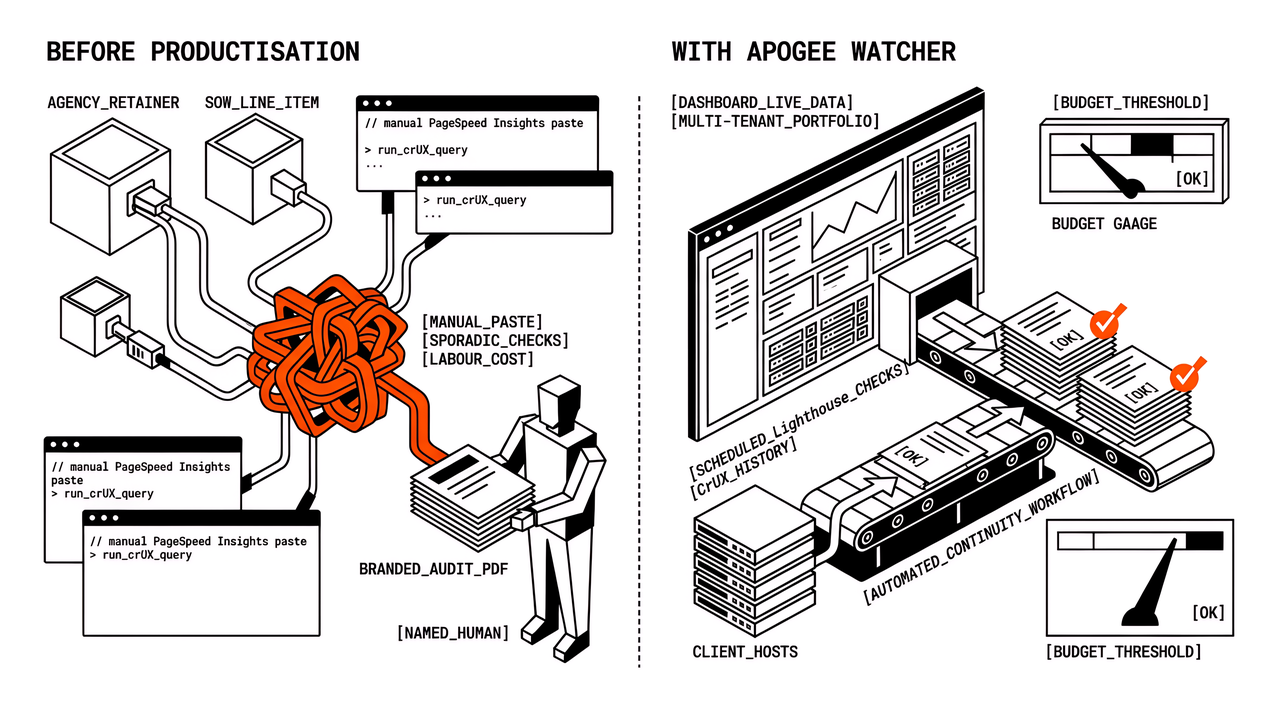
Apogee Information Systems has sold digital work since 2002. For a long stretch of that history, website speed showed up as a line on a statement of work: a PageSpeed Insights paste after a redesign, a Core Web Vitals fix sprint, a quarterly “we checked the homepage” slide. Clients paid for people and hours. The artefact they remembered was often a PDF.
When we built Apogee Watcher, we were not inventing a new category for its own sake. We were productising the part of the retainer that never scaled: keeping many client hosts on a dated lab and CrUX schedule without another Monday paste. What follows is that pivot story for founders who are deciding whether to turn an agency service into a product. It is not a revenue brag and it is not a feature dump. It is the decision path we wish we had written down earlier.
If you already run PageSpeed retainers and you are tempted to package “the report” as the product, start with the failure mode we rejected. If you are building tools for agencies, the same cut explains why multi-tenant monitoring and white-label PDFs are different jobs. Both audiences care about the same split: what software can keep honest on a calendar, and what still needs a named human on the retainer.
What a PageSpeed retainer looked like before the product
A typical performance retainer mixed three jobs that felt related and were not the same purchase.
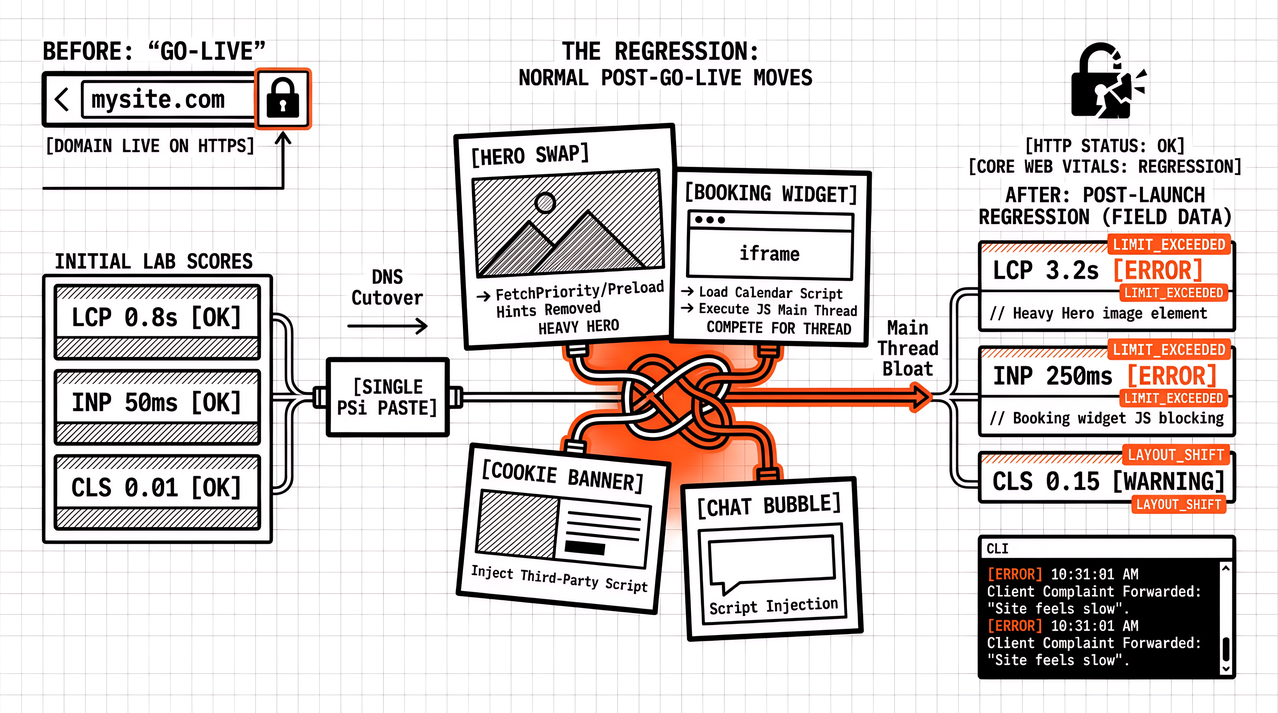
First came discovery and fixes: theme, hosting, images, third parties, templates. That work still needs humans. Second came proof for the client: screenshots, scores, a narrative for the account lead. Third came continuity: the same URLs checked again after the next plugin update, campaign landing page, or template ship. Continuity was the piece that quietly failed. Nobody wanted to own the calendar. The SOW said “monitor,” and the delivery looked like sporadic PageSpeed Insights runs when someone remembered.
We could sell that as a service forever. Agencies already do. The labour cost sits inside the retainer margin until the portfolio grows past the capacity of one careful developer. At that point you either hire, raise prices, or stop promising continuity. Productising the service only helps if you productise the job that broke first.
For the buyer map of how agencies price portfolio monitoring once they leave DIY, see Affordable Multi-Tenant Performance Monitoring Under $100/Month. For the monthly report loop after tests exist, see From Scheduled Tests to White-Label CWV Reports: A Monthly Retainer Workflow. Those posts assume the product already exists. What follows is why we built it.
Why another branded audit PDF was the wrong product bet
The obvious productisation move for a PageSpeed agency is a prettier report. Put your logo on a Lighthouse export, sell a self-serve audit, charge per PDF. The market already has free and paid checkers. Agencies already send branded decks. Competing on “a nicer screenshot of a score you could get from Google” is a thin moat.
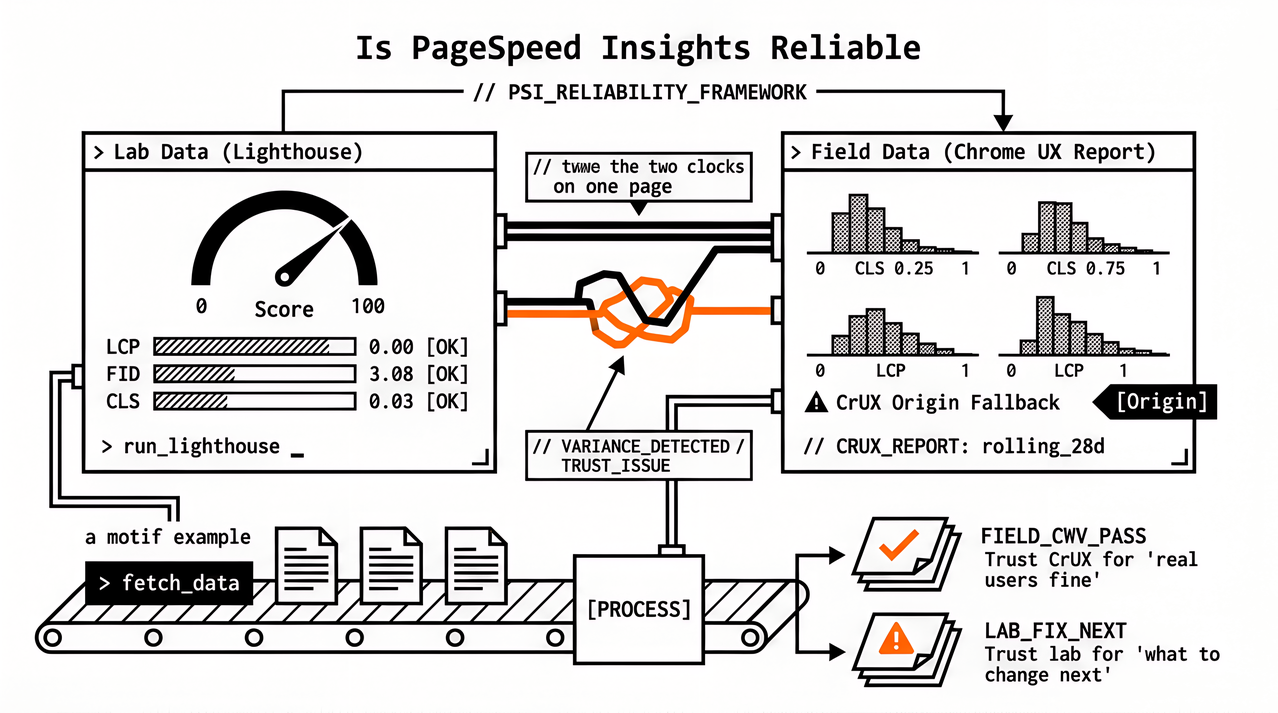
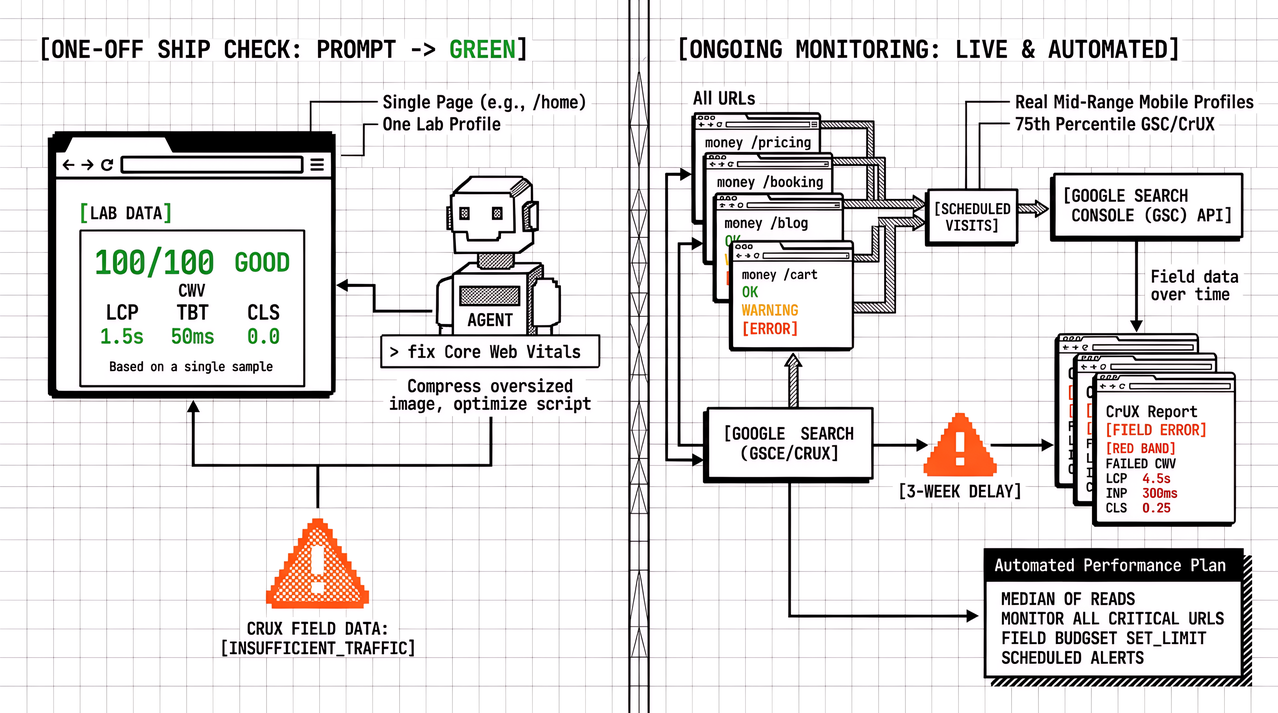
An audit PDF answers one question on one day: what does this URL look like right now? Retainers need a second question: did last month’s fix stick after the next content ship? A product that only sells the first question leaves the continuity problem inside the agency again. You have productised the commodity and kept the expensive habit unsolved.
We also rejected “AI that explains one PageSpeed Insights JSON” as the core product. Explaining a single run is useful. It is not multi-tenant monitoring. Site-level guidance that reads a domain-report snapshot is a later layer on stored evidence, not a substitute for the schedule. When that layer left beta, we documented the split between deterministic Summary and optional AI synthesis in Site-Level Guidance: AI Actionable Insights Leave Beta. The order mattered: evidence and schedules first, narrative second.
What we productised instead
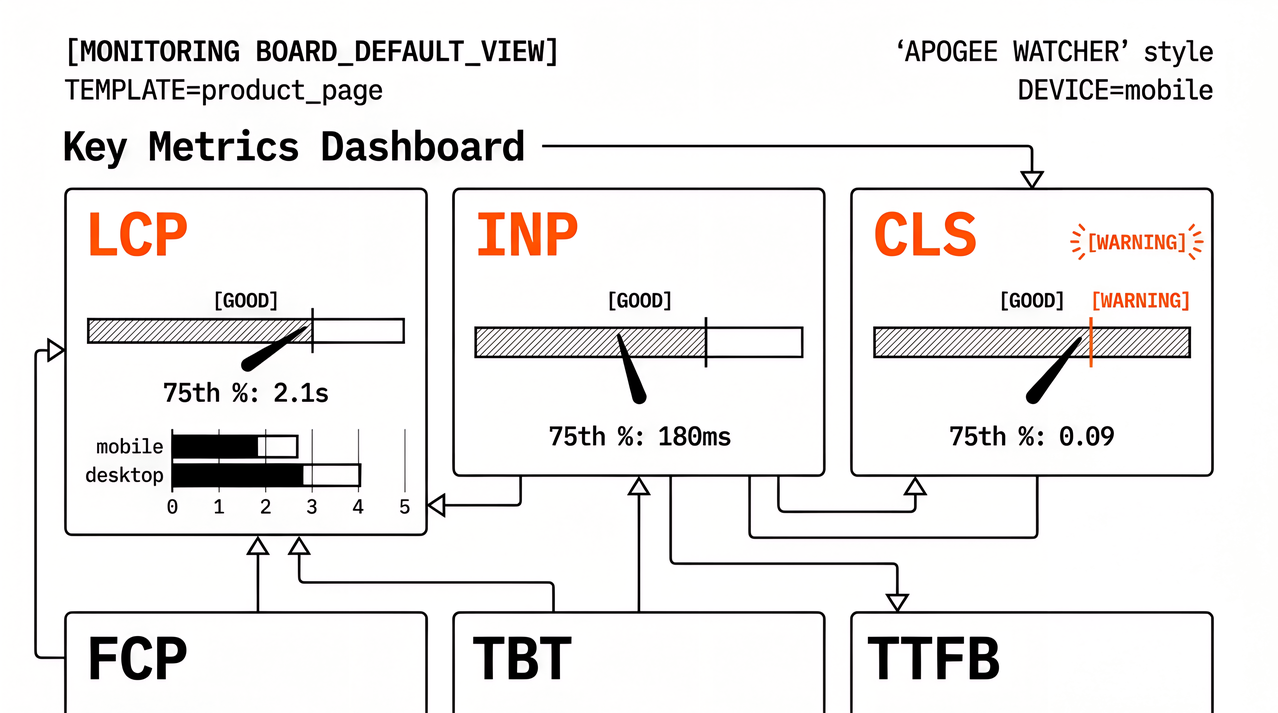
Watcher productises the continuity job: organisations hold many sites, sites hold pages discovered from sitemaps and crawls, and scheduled PageSpeed Insights runs store lab metrics plus CrUX field context when Google returns it. Budgets and alerts fire when scores move. Team roles keep account managers in Viewer mode without buying a seat per reader on a premium RUM plan. Domain reports and weekly organisation packs turn stored runs into something you can send without rebuilding a slide deck from scratch each month.
That shape is multi-tenant by design. Agencies do not buy monitoring the way a product team buys continuous synthetic coverage on one storefront. They buy portfolio coverage without placing a first-party RUM script on every client origin and without managing a Google API key per client. We hold the PageSpeed Insights relationship so the agency does not. Field context comes from CrUX in the result when it exists; we do not claim to replace Calibre-style RUM on a flagship site you fully control.
The product boundary is deliberate. Fix work, theme work, and hosting decisions stay in the retainer. The product owns the calendar, the history, and the shareable scoreboard. If you want the definitional framing of that category, What Is Automated Web Performance Monitoring? stays the short reference. For how a one-off PageSpeed Insights paste fails the same continuity test, PageSpeed Insights vs Automated Monitoring is the companion argument.
Service hours, product seats, and premium RUM compared
| Approach | What you sell | Scales with… | Breaks when… |
|---|---|---|---|
| Classic PageSpeed retainer | People + fixes + occasional PSI paste | Billable hours | Portfolio grows faster than staff |
| Branded audit PDF product | One-off lab report | Per-report or per-URL fees | Client asks “and next month?” |
| DIY scripts + Lighthouse CI | Engineering time + infra | Engineer capacity and API quota | Reporting and on-call stay manual |
| Multi-tenant PSI monitor (Watcher) | Scheduled lab + CrUX-in-PSI, orgs, alerts, reports | Org / site / test quotas | You need session-level RUM on one origin |
| Premium continuous + RUM (Calibre, DebugBear, SpeedCurve) | Deep synthetic + first-party RUM | Seats, synthetic packs, RUM sessions | Brochure long-tail burns the monitoring line item |
Agencies often need both a portfolio layer and a flagship RUM tool. That is the layer, do not replace stance we take in stack posts: Calibre or DebugBear on one or two owned origins where continuous synthetic depth and RUM pay for themselves, Watcher across the long tail of client hosts. Productising monitoring did not mean claiming we replaced every incumbent. It meant owning the job that our retainers already promised and could not keep by hand. The side-by-side with continuous monitoring brands is also spelled out in Calibre vs Apogee Watcher.
Layer, do not replace: the stack honesty that kept the product shippable
Rip-and-replace pitches sound bold in a landing page. They fail in agency sales cycles. Clients already have hosting, CMS, tag managers, and sometimes a RUM vendor on the money site. A new monitor that demands migration of every tool loses the deal before the trial starts.
Watcher ships as a schedule and a history store on public URLs. No client-side script is required for the core path. That constraint limited what we could claim and clarified what we could ship. We do not attribute Interaction to Next Paint to a single button in a logged-in session. We do tell you whether mobile Largest Contentful Paint on the homepage moved after last week’s theme update, with a dated run you can open again.
Founders productising an agency service often underestimate how much of the service brand is “we will figure it out.” Products cannot figure it out indefinitely. They need a narrow job with measurable inputs. For us the inputs were URLs, strategies, schedules, and stored PageSpeed Insights payloads. The service brand kept the consulting relationship. The product kept the calendar honest.
What stays in the agency after the product ships
Productisation is not a funeral for retainers; it is a cleaner split between what software can store on a schedule and what still needs a human judgment call. Agencies still sell diagnosis and implementation. They still write the narrative for a quarterly business review. They still decide whether a template change or a third-party tag caused the regression. Watcher makes the evidence cheaper to gather and harder to lose. White-label and weekly organisation reporting help the presentation layer; they do not replace the consultant who interprets trade-offs for a specific client stack.
If you are mid-pivot, a practical test helps. List the last ten hours you billed under “performance,” then mark which of those hours were fixing versus re-running the same URLs and rebuilding the same slides. The second pile is usually the better first product. The first pile stays as services until you have a different product thesis with its own measurable inputs.
We still use Watcher on our own properties and for client portfolios. The affiliate programme exists for people who already recommend the category; it is not the founding product story. The product story remains the schedule.
FAQ
Should every agency turn a service into a SaaS product?
No. Many retainers stay healthier as services. Productisation pays when one job repeats across clients, the inputs are measurable, and the delivery fails at portfolio scale. PageSpeed continuity met that bar for us. Custom redesigns did not.
Is “agency to SaaS product” the same as building a tool for agencies?
Not always. Building SaaS for agencies is a customer segment. Turning your delivery into a product is an operations cut. Our cut was internal continuity pain that matched an external buyer: agencies managing many hosts who cannot fund premium RUM on every brochure site.
Did you stop selling performance services?
No. Implementation and advisory stay human. The product owns monitoring history and alerts so the retainer can spend hours on fixes instead of paste-and-screenshot theatre.
How is this different from selling a white-label audit PDF?
An audit PDF is a one-day artefact. Monitoring is a series of dated runs on the same URLs. We productised the series. Reports sit on top of that series; they are not the product by themselves.
Where should a founder start if they want to productise a similar service?
A useful first pass is to write down the recurring job that breaks when client count doubles, then name the artefacts you already produce (URL lists, scores, alerts, PDFs). The smallest credible product is usually the system that stores those artefacts on a schedule and sits beside the retainer. It is not a replacement for the trust that closes advisory work, and it should not pretend to be.
Measure the calendar, then sell the fix
We sold PageSpeed retainers for years because clients needed faster sites and clearer reports. We productised monitoring because the calendar was the part of that promise we could not keep with paste alone. Another audit PDF would have productised the commodity. A multi-tenant PageSpeed schedule productised the habit.
If you run a portfolio today and the continuity job is already failing, try a multi-page sample at apogeewatcher.com/check or start a free Watcher account and put your noisiest client URLs on a dated schedule before you invent another report template.
References
- What Is Automated Web Performance Monitoring?
- Affordable Multi-Tenant Performance Monitoring Under $100/Month
- From Scheduled Tests to White-Label CWV Reports: A Monthly Retainer Workflow
- 3 Agency PageSpeed Stacks for 2026
- Site-Level Guidance: AI Actionable Insights Leave Beta
- PageSpeed Insights vs Automated Monitoring: When Manual Checks Aren't Enough
- Calibre vs Apogee Watcher: Continuous Monitoring for Agencies
- Apogee Watcher pricing
- Apogee Watcher features
- PageSpeed Insights API (Google for Developers)
About the author
- Apogee Information Systems operates at the intersection of digital transformation for international organisations, innovative e-learning, public service automation, and specialised commercial solutions. Currently building Apogee Watcher, a web performance tool for agencies and solopreneurs.
Comments
Join the discussionNo comments yet. Be the first to comment.