Benefits of automated monitoring that show up in retainers
Which advantages of automated web performance monitoring clients actually feel month to month, and which claims stay on the sales slide.
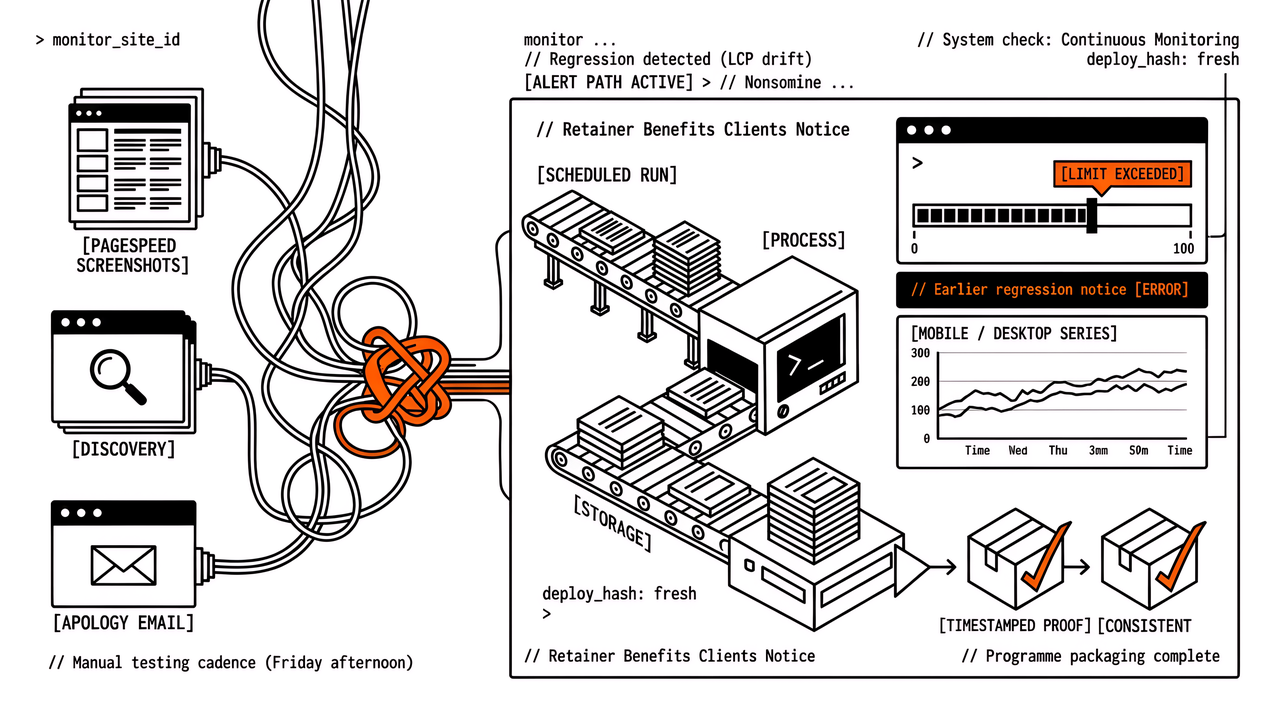
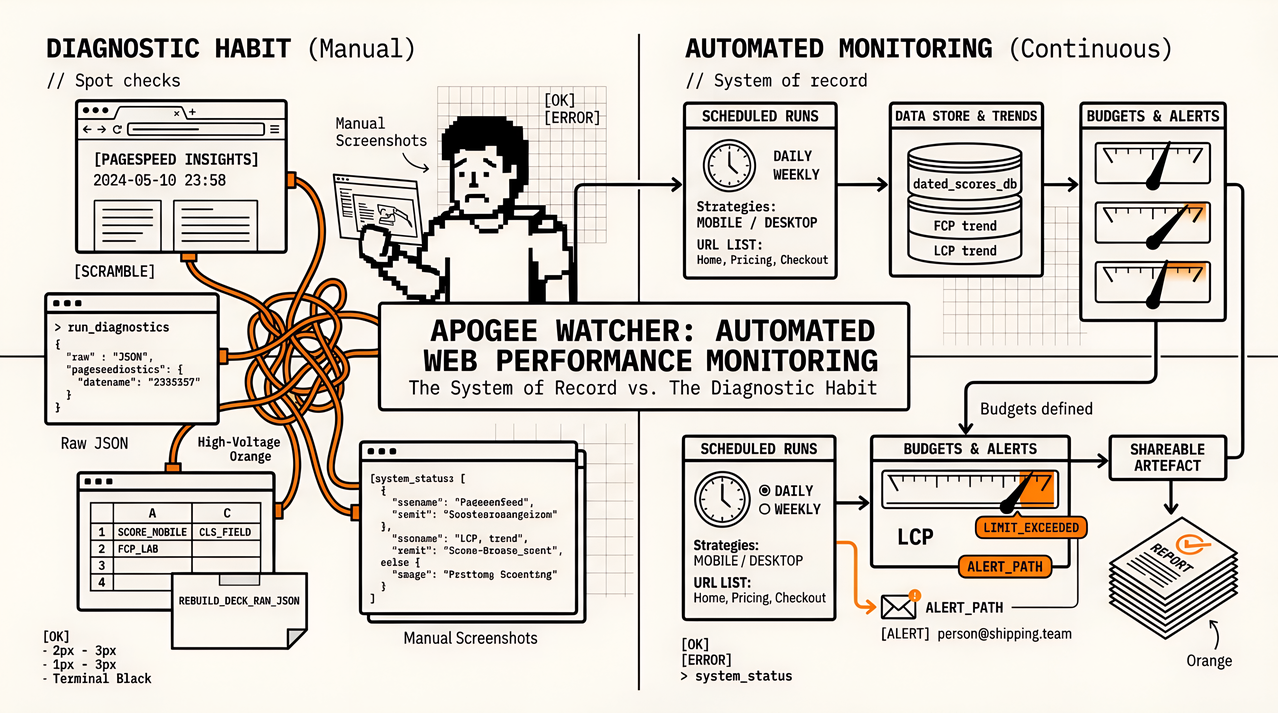
The retainer statement of work says “performance monitoring included.” The monthly pack that arrives is often still a handful of PageSpeed Insights screenshots, a short apology about a score that moved, and a promise to “keep an eye on it.” That gap is the real problem: buyers paid for continuity, and the deliverable still looks like a one-off diagnostic.
Vendors list many benefits of automated web performance monitoring, but only some of those benefits appear inside a retainer month after month. The rest stay on the sales slide until schedules, budgets, alerts, and a shareable history are actually running. What follows is the ops view: which advantages show up in client conversations, which ones do not, and how to write the honest ones into the SOW without promising ranks or auto-fixes.
For the fuller agency case (hours, roster tax, sellable monitoring), keep Why Agencies Need Automated Performance Monitoring in 2026 on the main blog. For the time and cost ledger behind automated versus manual testing, use Automated vs Manual PageSpeed Testing. What follows stays on retainer-visible outcomes: the benefits clients feel, the advantages that survive a renewal call, and the claims that should stay off the SOW.
Benefits of automated web performance monitoring clients notice in retainers
Searchers often ask for the benefits of automated web performance monitoring, or the advantages of using it. In retainer work those phrases point at the same five outcomes. Clients do not praise “automation” as a concept; they notice what changes in the monthly rhythm when the schedule, the alert, and the shareable pack are all present.
Earlier regression notice. A scheduled run catches a Largest Contentful Paint or Interaction to Next Paint drift between calls, not after the client forwards a Search Console screenshot. The benefit is calendar time: you open a ticket while the release is still recent enough to identify.
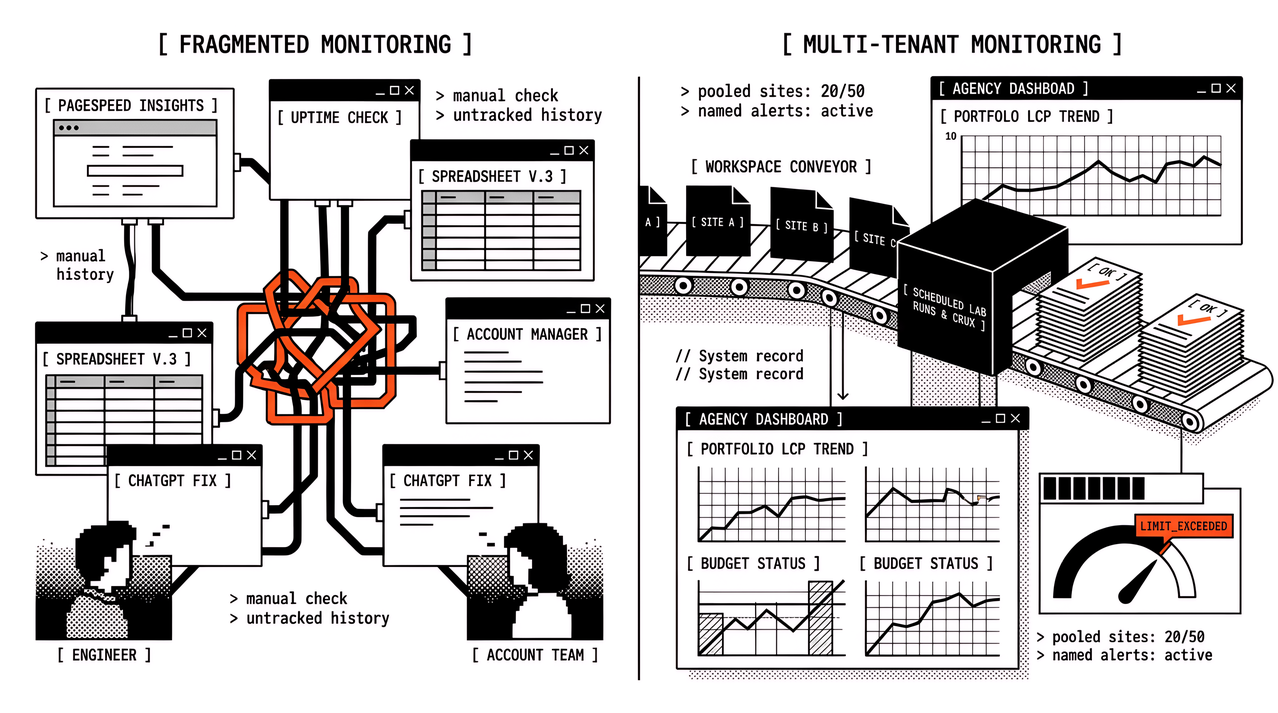
Hours that stop scaling with the roster. Discovery, paste-and-screenshot rituals, and deck assembly no longer grow one-for-one with every new URL. Humans still own triage and remediation; machines own repetition and storage.
Timestamped proof. A dated history is easier to defend in a quarterly review than a single Lighthouse capture from “sometime before the call.” Buyers who renew care about evidence they can reopen next month.
Consistent coverage. Mobile and desktop series, named thresholds, and alerts with cooldowns beat “whoever remembered to check.” Consistency is what makes the retainer feel like a programme rather than a favour.
A packageable line item. You can name monitoring as a value-add or a standalone fee without inventing a new spreadsheet ritual each month. That packaging only works when the five jobs above already exist.
Those advantages stick when monitoring means schedules plus budgets plus alerts plus reports. A nightly job that dumps raw results into a folder nobody opens is not the retainer benefit clients feel. The shareable pack and the alert path are what make the schedule visible outside the engineering team’s inbox.
Advantages versus manual PageSpeed testing on a retainer cadence
Manual PageSpeed testing is honest: someone opens PageSpeed Insights, pastes key URLs, and files the result. On a five-site roster with quiet release weeks, that can be enough. On a twenty-site roster with weekly deployments, the same ritual becomes the bottleneck that eats Friday afternoon and still misses Tuesday’s regression.
Automation changes the monthly rhythm, not the metric language. You still talk about Largest Contentful Paint, Interaction to Next Paint, and Cumulative Layout Shift. What changes is who remembers to run the test, whether last month’s number still exists, and whether a budget breach notifies someone before the client meeting. The advantages of automated web performance monitoring on retainer therefore look operational: fewer scramble emails, fewer “we will re-check and get back to you” threads, and a monthly pack that reuses the same series instead of rebuilding charts by hand.
The detailed hour and cost comparison lives on the Watcher guide linked above, so the retainer takeaway can stay short. Continuity is what the SOW sold; the monthly pack is where the client checks whether you still operate it. If that pack still depends on someone remembering to open a tab, you are selling continuity you do not yet run, and the scramble under the polished PDF will show up soon enough.
Benefits that do not appear just because you bought a schedule
Automation alone does not deliver every claim on a vendor list. Several promises circulate in sales copy and do not show up in retainers unless you add separate work. Treat the list below as a filter for proposal language before you promise outcomes the schedule cannot deliver on its own.
Not automatic ranking gains. Core Web Vitals can support Search visibility when they are poor enough to hurt, but a scheduled lab run does not move organic positions by itself. Do not sell monitoring as “we will rank you.” Sell the watch, the history, and the ticket that starts a fix, and leave ranking claims for work that actually changes content and links.
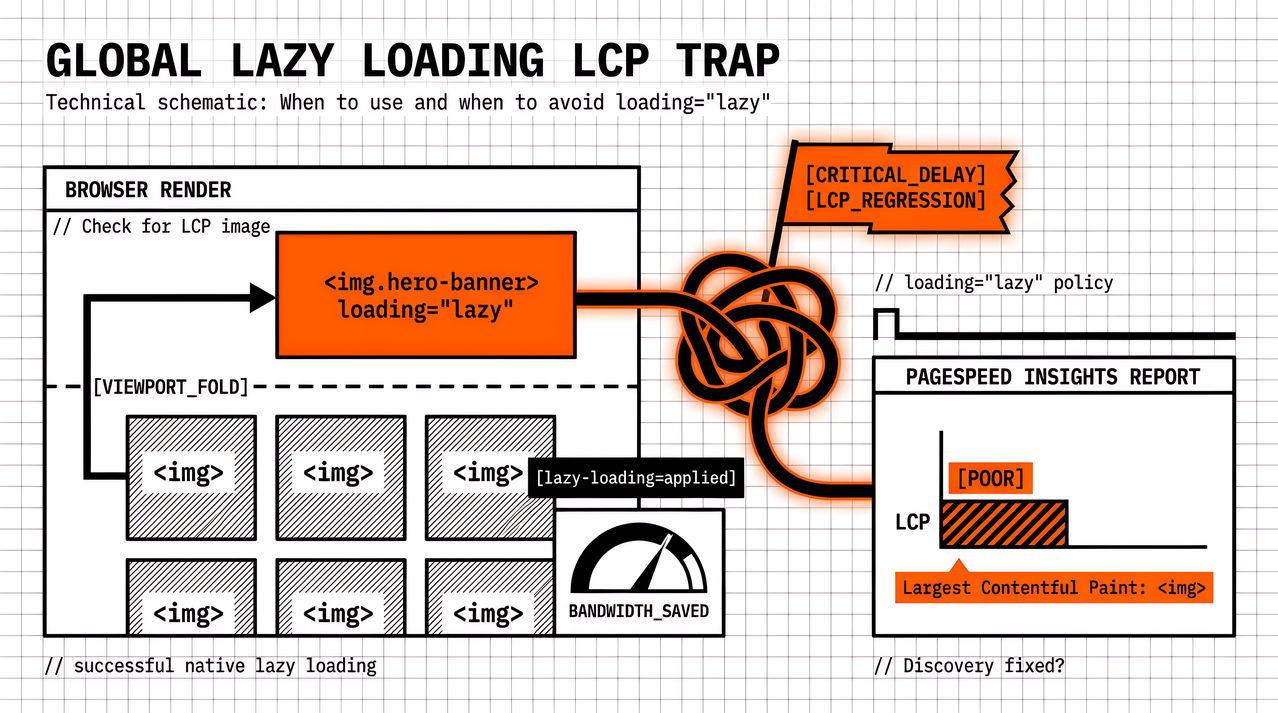
Not an auto-fix bot. Alerts tell you /checkout left budget. They do not compress images, remove a tag container, or rewrite a Magento theme. Remediation stays on humans or on a scoped delivery project, so the SOW should say detection and reporting, not silent repair.
Not uptime in disguise. HTTP 200 on the homepage is not Core Web Vitals health. Availability checks and performance schedules answer different questions. Clients who bought “monitoring” often blur the two, so keep the labels honest in the SOW.
Not a substitute for judgement. Thresholds need owners, cooldown policies need tuning, and URL lists need updates after redesigns. Without those human jobs, the schedule produces noise. The retainer then feels like spam rather than a watch the client asked for.
Name those limits early. Buyers who understand the boundary renew more calmly than buyers who expected a green dashboard to rewrite the theme. A short “what monitoring does not do” paragraph in the SOW prevents a painful quarter-end conversation when the schedule did exactly what it was designed to do and nothing more.
How to write those advantages into SOW and monthly packs
Turn the five retainer-visible benefits into language procurement and account leads can reuse. The aim is plain verbs and named artefacts, not tool logos or vague optimisation slogans. If a sentence cannot name the URL list, the schedule, the alert, or the monthly pack, it probably does not belong in the SOW.
In the SOW, prefer verbs over tool names: scheduled tests on agreed URLs, stored history for at least N months, alert when LCP / INP / CLS crosses named budgets, monthly shareable report. Avoid “continuous optimisation” and “AI-powered insights” unless you can point at a concrete artefact the client will receive each month. Procurement reads the verbs; account leads need the same wording in the pack so renewal does not invent a second story.
In the monthly pack, show the same URLs every month, highlight breaches and recoveries with dates, and separate lab schedules from field signals when both appear. One short paragraph on what changed since last month beats a wall of raw scores. If nothing breached, say so; silence is still a deliverable when the series proves it.
In the renewal conversation, point at tickets opened from alerts, hours not spent on paste rituals, and the archive the client can reopen. Those are the advantages of automated web performance monitoring that survive a finance review. Tool logos do not carry that weight when the ledger asks what the fee bought.
Agencies that already sell performance without promising position one will recognise the same boundary: sell what you can operate every week. Packaging guidance for that pitch already lives in Selling a performance retainer without “we will rank you #1” and in the Watcher selling guides that piece points to. Reuse that framing so the benefits list and the commercial language stay aligned.
FAQ
What are the advantages of automated web performance monitoring for an agency retainer?
The same cluster as the benefits list: earlier regression notice, hours that stop scaling with client count, timestamped proof, consistent mobile and desktop coverage, and a packageable line item. Advantages and benefits queries usually want that operational set, not a generic uptime brochure. If a vendor page only lists “peace of mind,” ask which of those five artefacts they ship every month.
Does automated monitoring replace manual PageSpeed Insights checks?
No. Spot checks stay useful for investigation when a metric moves or a release looks odd. Automation replaces the calendar ritual of “remember to paste every Friday,” not the diagnostic skill of reading a waterfall when something breaks, so both still belong in a healthy retainer.
Will clients see Search ranking lifts from monitoring alone?
Not reliably. Monitoring makes experience problems visible in history and alerts. Ranking moves need content, links, and competitive context as well, so keep monitoring claims on detection, history, and reporting.
Is website uptime monitoring the same benefit?
No. Uptime answers availability, while web performance monitoring answers load, interactivity, and layout stability. Sell both when the retainer promises both, and do not treat one green light as the other.
CTA
If your retainer already promises monitoring, audit one client this week: URL list, schedule, budget language, alert path, and last month’s shareable artefact. If any of those five are missing, the benefits of automated web performance monitoring are not yet showing up in that retainer, whatever the tool invoice says. Fix the missing job before you add more URLs.
When you want the agency-scale case and the time ledger in one place, start with the two Watcher guides linked in the opening, then tighten the SOW wording above so next month’s pack matches what you sold and the advantages you named in the proposal still appear in the client folder.
References
Why Agencies Need Automated Performance Monitoring in 2026 (Apogee Watcher)
Automated vs Manual PageSpeed Testing: A Time and Cost Comparison (Apogee Watcher)
PageSpeed Insights (Google)
Web Vitals (web.dev)
What is Web Performance Monitoring and What is it Good For? (WhatsUp Gold; generic benefits framing peers)
7 Unexpected Benefits of Web Performance Management Software (Calibre; SERP peer for benefits queries)
Selling a performance retainer without “we will rank you #1” (Apogee Watcher Hashnode)
About the author
- Apogee Information Systems operates at the intersection of digital transformation for international organisations, innovative e-learning, public service automation, and specialised commercial solutions. Currently building Apogee Watcher, a web performance tool for agencies and solopreneurs.
Comments
Join the discussionNo comments yet. Be the first to comment.